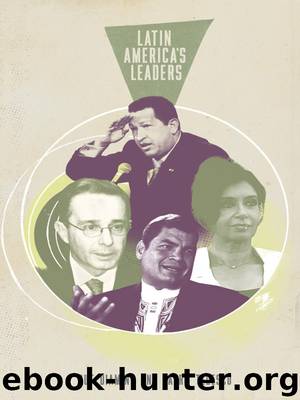
Latin America's Leaders by Rut Diamint
Author:Rut Diamint
Language: eng
Format: epub
Publisher: Zed Books
Published: 2015-09-05T16:00:00+00:00
The reasons for the crisis in Ecuador
In Ecuador, economic instability and unpopular government decisions brought about the collapse of the political party system. Historically Ecuador had strong political leaders. Juan José Flores, José María Velasco Ibarra and León Febres Cordero are, among others, examples of the strong caudillos that have dominated Ecuador’s political history. Political parties have also been historically significant. By the end of the 1990s, Ecuador’s party system seemed to be consolidated around the Partido Social Cristiano, the Partido Roldosista Ecuatoriano, Izquierda Democrática and Democracia Popular. There were also new initiatives such as Movimiento Pachakutik.
Like other countries in the region, Ecuador was able to stabilize its economy at the beginning of the 1990s. Thanks to this stabilization, the country received foreign investment and achieved economic growth. However, in 1995, under the presidency of Sixto Durán Ballén, the war against Peru over a border dispute started a period of political and economic uncertainty that exploded in 2002.
In 1996 Abdalá Bucaram won the elections with the Partido Roldosista Ecuatoriano. As soon as he took office, he changed his economic preferences and turned from a populist strategy to a neoliberal one which promoted privatization and a currency scheme quite similar to the convertibility plan implemented in Argentina. While Carlos Menem in Argentina and Alberto Fujimori in Peru were able to transform themselves from populist to neoliberal advocates without jeopardizing their popularity, Bucaram could not. Seven months after he was elected, he faced a huge popular demonstration against the austerity measures and mounting corruption. Bucaram was impeached and political instability deepened. From his impeachment until Rafael Correa’s election, Ecuador witnessed more economic instability and unpopular government decisions that finally caused the collapse of the political party system. There were seven presidents in less than ten years. After the ‘dollarization’ of the economy, President Jamil Mahuad was forced to resign in January 2000, leading to another period of political uncertainty that did not end when Lucio Gutiérrez won the 2002 general elections (Freidenberg 2008).
After participating in the 2000 coup against Mahuad, Gutiérrez formed the Partido Sociedad Patriótica, which, in an alliance with Movimiento Pachakutik, helped him to win the 2002 presidential elections (Van Cott 2008). Their platform was based on the transformation of the neoliberal agenda and the fight against corruption; but, once he was in office, Gutiérrez reversed his strategy and was unable to maintain his power. He broke his political alliance with left-wing parties and moved closer to the conservative Partido Social Cristiano (PSC). However, this alliance did not last very long and the PSC and Movimiento Pachakutik pushed for Gutiérrez’s impeachment (Montúfar 2008). He was finally dismissed in 2005 owing to increasing social unrest and demonstrations, which were held mainly in Quito. As in Argentina, the slogan was que se vayan todos. But in Ecuador this became a reality. The political party system collapsed and a thoroughgoing revival of the political elite took place. The traditional parties, from both left and right, were discredited. Former finance minister Rafael Correa won the 2006 presidential elections and assumed office in January 2007.
Download
This site does not store any files on its server. We only index and link to content provided by other sites. Please contact the content providers to delete copyright contents if any and email us, we'll remove relevant links or contents immediately.
The Secret History by Donna Tartt(19034)
The Social Justice Warrior Handbook by Lisa De Pasquale(12183)
Thirteen Reasons Why by Jay Asher(8885)
This Is How You Lose Her by Junot Diaz(6873)
Weapons of Math Destruction by Cathy O'Neil(6261)
Zero to One by Peter Thiel(5782)
Beartown by Fredrik Backman(5734)
The Myth of the Strong Leader by Archie Brown(5495)
The Fire Next Time by James Baldwin(5426)
How Democracies Die by Steven Levitsky & Daniel Ziblatt(5211)
Promise Me, Dad by Joe Biden(5141)
Stone's Rules by Roger Stone(5080)
A Higher Loyalty: Truth, Lies, and Leadership by James Comey(4946)
100 Deadly Skills by Clint Emerson(4914)
Rise and Kill First by Ronen Bergman(4776)
Secrecy World by Jake Bernstein(4739)
The David Icke Guide to the Global Conspiracy (and how to end it) by David Icke(4697)
The Farm by Tom Rob Smith(4501)
The Doomsday Machine by Daniel Ellsberg(4482)
